Outdoor advertising in Extremadura: bus shelters, MUPIs and billboards in Badajoz and Mérida

Prices in Extremadura · per face per week
- 8x3 m billboardsfrom €76
- 6-sheet MUPIsfrom €120
- Bus sheltersfrom €120
Prices exclude VAT · printing and posting from €35 per face
Outdoor advertising sites in Extremadura
Our Extremadura network runs to more than a hundred outdoor advertising sites – bus shelters, MUPI street panels and large-format billboards – concentrated in the two cities that account for most of the region's commercial activity: Badajoz and Mérida. The region has 1,053,345 inhabitants according to the 2025 population census from Spain's National Statistics Institute (INE), across an area of slightly more than 41,000 square kilometres, which makes it the fifth-largest region in the country by area and the natural frontier between the centre of the peninsula and Portugal. Average population density is 25.3 inhabitants per square kilometre, one of the lowest in Spain, which translates into a great deal of travel by road and a commercial life concentrated in the larger towns and cities. The A-5 runs through the region from east to west as far as the Caya border crossing, and the A-66 (Vía de la Plata) crosses it from north to south, so the approach roads into Badajoz and the Mérida interchange are unavoidable for Madrid–Lisbon traffic and for journeys across the interior of the peninsula.
Marco Visual's footprint in Extremadura is concentrated in Badajoz, with nearly ninety advertising sites covering the city's main corridors (Avenida de Europa, Ronda del Pilar, Avenida de Juan Sebastián Elcano, Avenida de Elvas and the BA-20 approaches towards the El Faro shopping centre), and in Mérida, with more than forty sites on Avenida de la Reina Sofía, Avenida de la Libertad and Avenida de Portugal and around the Hospital de Mérida and the El Foro and La Corchera shopping centres. The bus shelter is the dominant format, especially in residential neighbourhoods and along public transport corridors, while billboards are reserved for the road approaches and for the N-630 (Vía de la Plata) where it crosses the region. MUPIs stand at roundabouts and on the busiest avenues, ideal for campaigns with a tactical focus. The inventory sits close to recognisable landmarks such as El Corte Inglés (the Spanish department store chain), Carrefour, Lidl, the Hospital Universitario de Badajoz, the University of Extremadura and two event venues, IFEBA (the Badajoz trade fair centre) and the Plaza de Toros de Mérida bullring.
Extremadura offers three particularly strong commercial windows for an outdoor campaign. The first is the Carnaval de Badajoz in February, officially listed as of International Tourist Interest, which fills the city centre and the Santa Marina and San Roque neighbourhoods for ten days with parades, murgas (satirical singing groups), comparsas (costumed troupes) and the official murga contest (Concurso Oficial de Murgas) at the Teatro López de Ayala, which draws tens of thousands of people. The second is the Feria de San Juan (Badajoz's midsummer fair) at the end of June, a local festival with more than seven hundred years of tradition, bringing marquees, concerts and a bullfighting programme to the Caia fairground. The third is the Festival Internacional de Teatro Clásico de Mérida, a classical drama festival that every summer (between July and August, with almost a century of history since 1933) turns the Roman Theatre, a UNESCO world heritage site since 1993, into an international stage. Sectors such as hospitality, retail, automotive and services plan their most profitable activations of the year here.
In our campaign planner you can check the price of MUPIs and every other advertising site, real photos, the exact location, Google Street View, descriptions and nearby points of interest, dimensions, print format… Best of all, you can filter the sites and pick the ones you want, then plan and book the outdoor advertising campaign
Some links open pages in Spanish
Looking for another area?
Explore the different outdoor advertising formats in Extremadura
Marco Visual is an online platform for managing and booking campaigns on outdoor advertising sites. Our website gives you all the information you need to plan and book an outdoor campaign. Get to know each site and its features: price, real photos, format, minimum booking period and other terms.
Outdoor sites are ideal for promoting events, with room on the ad for the venue, who is taking part and every other detail that matters. They are also widely used for branding, so that people start seeing a brand away from the screen and remember it better. Other common uses are launching offers (Black Friday, the sales, Christmas…) and opening new shops.
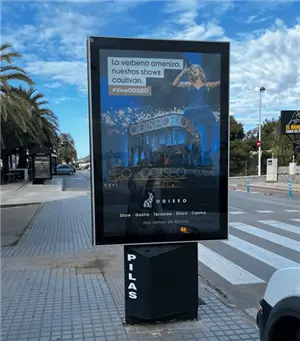
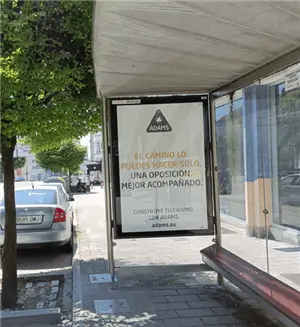
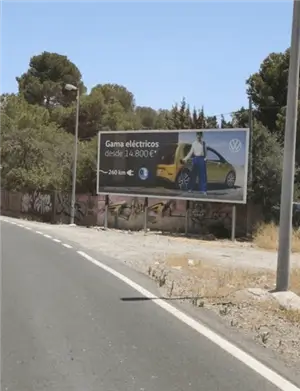
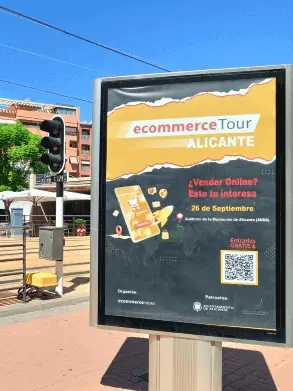
Here are some of our campaigns on different outdoor advertising sites:
The benefits of outdoor advertising in Extremadura
Consumers in Extremadura move around differently from those in large metropolitan areas. Average population density in the region is 25.3 inhabitants per square kilometre, one of the lowest in Spain, which means a great deal of road travel between towns and a commercial life heavily concentrated in the centres of Badajoz and Mérida. According to Spain's National Statistics Institute (INE), net income per person in the province of Badajoz was €11,158 a year in 2022, among the lowest in the country, which points to a below-average purchasing power profile in which local shops, food hypermarkets and basic services count for more than premium brands. Slightly more than half the population is in the labour market, and public-sector employment carries far more weight than the Spanish average, especially in Mérida, home to the Junta de Extremadura (the regional government). Bricks-and-mortar retail keeps a high market share compared with e-commerce, and the street is still where a significant part of the local audience naturally discovers brands. Here outdoor works as a democratic channel, reaching the whole population at a very competitive cost per impact compared with paid digital.
Seasonality shapes the advertising calendar in the region. The Carnaval de Badajoz, officially listed as of International Tourist Interest, fills the city centre and the Santa Marina and San Roque neighbourhoods for ten days in February, with visitor numbers that multiply trade for hospitality, clothing shops and nightlife. The Festival Internacional de Teatro Clásico de Mérida draws tens of thousands of visitors in July and August to Mérida's archaeological ensemble, a UNESCO world heritage site, with an audience of above-average purchasing power from Spain and abroad. The Feria de San Juan in Badajoz at the end of June drives hospitality, leisure, automotive and retail for ten days around the Caia fairground. For sectors such as automotive, household appliances, furniture and education, the weeks before each of these events are the strongest commercial windows of the year, and outdoor is the channel with the best recall over short periods with a high density of impacts. A campaign planned three weeks ahead on bus shelters and MUPIs usually achieves effective coverage of local residents that is hard to match with other media at the same cost.
Compared with digital and local radio, outdoor gives brands a visual presence on residents' daily journeys: from their neighbourhood to work, from work to school, from the centre to the hypermarket. It is particularly effective for sectors where the purchase decision is made close to the point of sale. Car dealerships and automotive aftersales are a natural fit for Avenida de Adolfo Díaz Ambrona and the area around the BA-20 in Badajoz, where the car brands cluster; private clinics and medical centres make the most of Avenida de Elvas and Avenida de Augusto Vázquez, given how close they are to the Hospital Universitario; schools and tuition centres depend on coverage of the residential corridors (Avenida de Sinforiano Madroñero, Avenida de Damián Téllez Lafuente and the Las Vaguadas residential estate). Restaurants with a set lunch menu, estate agents and retail franchises get particularly good returns from bus shelters in the city centre. Combining bus shelters in residential neighbourhoods with billboards on the road approaches gives full coverage of a market of manageable size, where a mid-sized budget reaches practically the entire target audience within a few weeks, something that is not feasible in large metropolitan areas at the same cost per contact.
In your marketing and communications strategy, outdoor advertising sites are essential for reaching your audience. They are an excellent way to catch the eye of people out and about in town, thanks to well-chosen locations and high visibility.
- Eye-catching visual advertising with 24/7 visibility in high-traffic areas.
- Strategic locations on the city’s main streets and avenues.
- Wide coverage: a presence in Spain’s main cities and regions.
- High visibility in carefully chosen spots for the greatest impact.
- Geographic targeting: choose the areas and neighbourhoods where your target audience is.
- Greater brand awareness and trust.
- Flexibility for short and long campaigns.
- A non-intrusive medium that helps the message stick when combined with social media campaigns.
Some of the links in the areas below open pages in Spanish.
Outdoor advertising in Badajoz
- Population: 150,209 inhabitants according to INE 2025 data, while the municipal register stood at around 154,400 residents at the end of 2025, the highest figure in the city's history.
- Gender split: roughly 51% women and 49% men.
- Average age: around 44, slightly below the regional average thanks to the large university population.
- Purchasing power: below average, with an economy based on public services, retail, healthcare, the university and a logistics role on the Madrid–Lisbon corridor.
- Economic activity rate: around 55%, with a strong presence in public administration, healthcare, education and retail.
- Relevance for advertising: the main urban market in Extremadura and the only city in the region with more than 100,000 inhabitants, with cross-border flows towards Portugal's Alentejo.
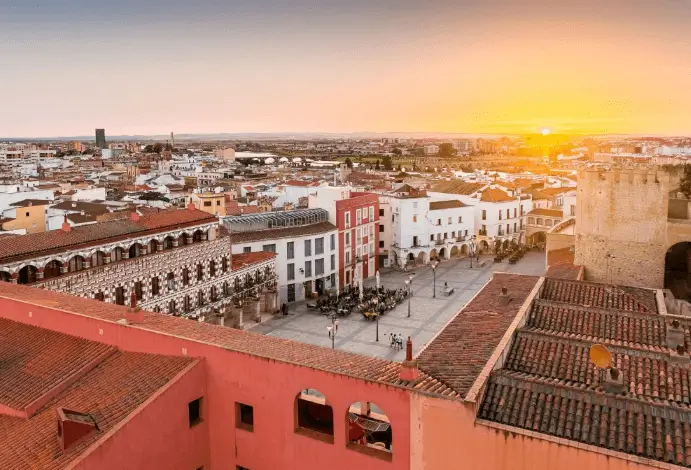
Badajoz is the most populous city in Extremadura and the region's main economic, commercial and services centre, on the river Guadiana, 6 kilometres from the border with Portugal. Its role as a provincial capital, the University of Extremadura (with a campus on Avenida de Elvas) and the Hospital Universitario make it a services hub for the whole south-west of the peninsula and for Portugal's Alentejo. The municipality of Badajoz is one of the three largest in Spain by area, at around 1,440 square kilometres, which adds outlying districts and smaller settlements to the main urban market. The Carnaval de Badajoz, officially listed as of International Tourist Interest, together with the Feria de San Juan at the end of June, gives the city its two big commercial windows, alongside a regular calendar of trade fairs at IFEBA and sporting events at the Nuevo Vivero stadium.
In Badajoz the inventory is concentrated in bus shelters and MUPIs spread along some ten main avenues: Avenida de Europa, Ronda del Pilar, Avenida de Juan Sebastián Elcano, Avenida de Ramón y Cajal, Avenida de Elvas, Avenida de Ricardo Carapeto, Avenida de Sinforiano Madroñero and Avenida de Damián Téllez Lafuente. The billboards stand on the BA-20 approaches (opposite the El Faro shopping centre and on the exit towards Portugal), on Carretera de Madrid next to the PEALSA industrial estate and on Carretera de Valverde next to the Carrefour. There are also sites near easily recognised landmarks: the El Corte Inglés on Avenida de La Libertad, the Hospital Infanta Cristina, the railway station, BBVA, IFEBA and the main shopping centres.
Bus shelters in Badajoz
Bus shelters have the largest inventory of any format in Badajoz and give a local SME the best coverage. They stand at city bus stops and offer extended exposure to pedestrians, public transport users and drivers moving at moderate speed along the avenues. They are a particularly good fit for clinics, neighbourhood shops, tuition centres, hospitality and financial services, where the target audience is the resident who passes the same stop several times a week.
Highlights include Avenida de Europa (numbers 5 and 10, opposite the Consejo de Fomento), Ronda del Pilar (next to the Colegio Lope de Vega and next to Bar La Once), Avenida de Juan Sebastián Elcano (at the junction with Marín de Rodeza and opposite the school), Avenida de Elvas (the university, the entrance to the Hospital Infanta Cristina and the El Faro shopping centre), Avenida de Ricardo Carapeto (numbers 7, 14, 67, 89 and 140), Avenida de Sinforiano Madroñero (numbers 10, 15, 17 and 25), Avenida de Damián Téllez Lafuente, Avenida de Carolina Coronado next to the railway station, Avenida del Perú, Avenida de la República Dominicana, Carretera de Valverde next to the Carrefour and the Santa Clara neighbourhood.
MUPIs in Badajoz
MUPIs are a premium format in Badajoz for campaigns with a tactical focus: a product launch, a shop opening, an event announcement or a one-off promotion. Their size makes room for more visual messages, and they are placed in areas with heavy footfall and at roundabouts with plenty of road traffic. For sectors such as fashion, telecoms, automotive and financial institutions, they are the format of choice when the aim is visual impact and concentrated awareness.
The main MUPI sites in Badajoz are Plaza de Santo Domingo (number 1), Plaza de San Atón opposite the church, the Isabel de Portugal roundabout, Avenida María Auxiliadora at Paseo Condes de Barcelona, the roundabout on the Badajoz–Cáceres road, the area around Avenida de Adolfo Díaz Ambrona next to the Hotel Lisboa, Calle de Federico Mayor Zaragoza, Avenida de Elvas at the junction with Federico Mayor Zaragoza, the Hospital Universitario cafeteria, Calle del General Manuel Saavedra Palmeiro, Avenida de Vicente Marcelo Nessi next to the Carrefour, Avenida de Luis de Góngora opposite number 6, Calle de Francisco Guerra (number 8) and Avenida de Alcaraz y Alenda (number 41).
Billboards in Badajoz
Our Badajoz billboards are concentrated on the road approaches and along the main commercial corridors. They work especially well for brand awareness campaigns, for national or regional advertisers with a presence in several cities and for capturing traffic from outside the city centre: Portuguese traffic coming across the border, Madrid–Lisbon traffic on the A-5 and trips to out-of-town shopping centres. Typical sectors: automotive, hypermarkets, dealerships, fairs and events.
The main billboard sites in Badajoz are Carretera de Madrid on the BA-20, at the roundabout opposite the car dealerships on the PEALSA industrial estate, heading into the centre; Avenida de Juan Sebastián Elcano on the corner with Calle de José María Giles Ontiveros, heading towards Carretera de Sevilla; Avenida de Elvas on the BA-20 opposite the El Faro shopping centre, heading towards Puente Real; Avenida de Elvas on the BA-20 opposite the El Faro shopping centre, heading towards the Palacio de Congresos conference centre, IFEBA and Portugal; and Carretera de Valverde next to the Carrefour, at the junction with Avenida de Vicente Marcelo Nessi and the Las Vaguadas residential estate.
Outdoor advertising in Mérida
- Population: 60,225 inhabitants according to INE 2025 data, the third most populous city in Extremadura after Badajoz and Cáceres.
- Gender split: roughly 51% women and 49% men.
- Average age: around 44, with steady population growth since 2000.
- Purchasing power: average, with an economy based on public administration (the Junta de Extremadura), cultural tourism, services and retail.
- Economic activity rate: around 55%, with a large share of jobs in the public sector, hospitality and retail.
- Relevance for advertising: the seat of the region's institutions and a traffic hub on the A-5 and the A-66, with repeat visitors during the Festival de Teatro Clásico.
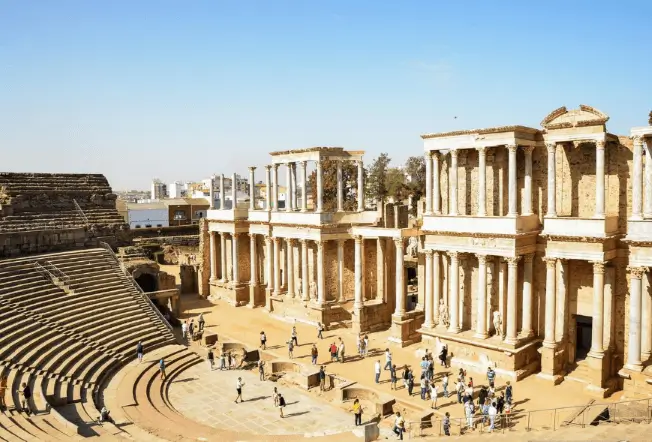
Mérida is the administrative capital of Extremadura and the seat of the regional government (the Junta) and of the regional parliament, which gives it far more public-sector weight than its population would suggest. The city is crossed by the A-5 (Madrid–Lisbon) and the A-66 (Vía de la Plata, Seville–Asturias), a junction that makes it the logistics hub with the heaviest traffic in the whole region. Its archaeological ensemble (Roman Theatre, amphitheatre, circus, aqueducts, Temple of Diana) has been a UNESCO world heritage site since 1993, and the Festival Internacional de Teatro Clásico, held every summer since 1933, draws thousands of visitors between July and August. Average income in Mérida is the second highest in the province of Badajoz, thanks to the weight of public-sector jobs and skilled services.
The inventory in Mérida is mainly made up of bus shelters and MUPIs, with a strong presence on Avenida de la Reina Sofía (one of the main commercial corridors, with Lidl, Sepansa, the El Foro shopping centre and SEAT and Renault dealerships), Avenida de la Libertad, Avenida de Portugal next to the Carrefour, Avenida Juan Carlos I, Avenida de las Américas, Avenida de Vía de la Plata, Paseo de Roma, Avenida Eugenio Hermoso and strategic roundabouts such as Puente Lusitania, Fernández López and Isabel de Portugal. There are also sites on residential estates (Montealto, El Prado and Mirando al Río) and next to well-known facilities such as the Plaza de Toros, the health centre and the Hospital de Mérida cafeteria.
Bus shelters in Mérida
Mérida has more bus shelters than any other format, and they cover the main residential and commercial corridors. They are an ideal vehicle for local shops, hospitality, clinics, tuition centres and professional services, with extended exposure to residents and city bus users. The density of sites on Avenida de la Libertad and Avenida de Vía de la Plata makes it possible to build compact packages with effective coverage of much of the city centre.
Highlights include Avenida de la Libertad (Paseo Luis Rosales, number 51 next to the Lusitania roundabout and next to the retirement home), Avenida de las Américas (number 19), Avenida Eugenio Hermoso, Avenida de Alange, Avenida de Portugal next to the Carrefour entrance and next to the El Foro shopping centre, Avenida Juan Carlos I (number 40 next to the state school and next to the Renault dealership), Avenida de Vía de la Plata (number 35), Avenida de la Reina Sofía next to the Lidl, Calle de Mario Roso de Luna (number 15), Calle de Oviedo next to the Plaza de Toros, Paseo de Roma, the Montealto residential estate and the María Auxiliadora neighbourhood.
MUPIs in Mérida
Mérida's MUPIs sit at the busiest roundabouts and avenues, especially on the approaches to the centre and along the commercial corridor of Avenida de la Reina Sofía. They are the most suitable format for mid-budget campaigns looking to combine visual impact with a sustained presence, and they are large enough for messages with a clear hierarchy that read well from a distance. Recommended sectors: automotive, telecoms, retail, cultural events and financial institutions.
The main MUPI sites in Mérida are the Fernández López roundabout, Avenida Fernández López (numbers 1 and 42), Avenida de la Libertad (number 51), Paseo de don José Álvarez Sáenz de Buruaga, Avenida de la Constitución opposite Telefónica, the junction of Calle de Nuestra Señora de la Antigua with Avenida de la Reina Sofía, Avenida de la Reina Sofía opposite the Lidl, Calle de Almendralejo (number 58), the roundabout on Calle Juan Cané next to the La Corchera shopping centre, the El Foro shopping centre roundabout heading towards Badajoz, the roundabout by the SEAT dealership heading towards Madrid and the Puente Lusitania roundabout opposite the Cachicho restaurant.
How booking outdoor advertising with Marco Visual works
Tell us what you’re looking for
If you’d rather choose yourself, our campaign planner (in Spanish) lets you pick the weeks and then browse the map or the list of sites, with filters by type of site, city, postcode or distance to a shop or point of interest. Bear in mind the booking cycles: many sites are sold by the week, but most 8x3 m billboards are booked in two-week periods or for 26 weeks, so they’re greyed out if you pick a single week. Click ‘Siguiente’ (Next) and you’ll see a campaign summary with the total price, printing and posting included: we take care of everything. You just enter your contact details and create the campaign.
Either way, you get a unique link to your campaign page, which you can share with your team: the sites you picked, the weeks, the price and the guides for preparing your artwork. You can check it whenever you like.
We confirm availability so you can book online
When everything is cleared, you can enter your billing details on that same page, pay by bank transfer and upload your artwork. Once you’ve paid, upload the transfer receipt so we can confirm the booking sooner.
Remember to send your artwork, following the guides, before the deadline shown on the proposal (usually 10 days before the start). We’ll email you at every step: artwork received and approved, payment received, sites confirmed.
Printing, posting and launch
These photos are usually ready 24 to 48 hours after the start; we’ll email you when they are.
When the campaign ends, you’ll see a notice on the campaign page and receive a satisfaction survey, with the option of leaving us a Google review. It helps us do better.
Frequently asked questions about outdoor advertising in Extremadura
How much does an outdoor advertising campaign cost in Extremadura?
It depends on the format, the number of faces, the length of the campaign and the location. As a guide, a two-week campaign on MUPIs or bus shelters in Badajoz or Mérida usually comes to around €240 for small or medium-sized packages, and rises from there when poster production, several areas or billboards on the approach roads into the city are included. We prepare a fixed quote with the exact sites before you commit to anything. For billboards in Extremadura the guide price is €76 per face per week – that is, €152 per fortnight – excluding VAT and poster printing, which we quote separately; billboards are booked by the fortnight (2 weeks, 14 days).
Which formats work best for a local SME in Badajoz or Mérida?
For local shops and services, bus shelters offer the best cost-to-impact ratio: they are concentrated on avenues with constant pedestrian and road traffic. MUPIs work very well for seasonal campaigns and launches, especially in the city centre and next to shopping centres. Billboards on the BA-20 or on the A-5 and N-630 approaches come into their own when the goal is brand awareness or drawing in traffic from outside the city.
How many advertising sites does Marco Visual have in Extremadura?
We have over a hundred active advertising sites spread between Badajoz and Mérida, with bus shelters as the dominant format, a solid base of MUPIs and a network of large-format billboards on the approaches to Badajoz. The inventory is updated fairly often, so we confirm the exact number and the available locations when we prepare your proposal.
What is the minimum campaign length?
The usual minimum duration is 14 days for MUPIs, bus shelters and billboards. It is the industry's standard unit and builds up enough impacts for the campaign to be measurable. For very specific tactical activity (announcing a one-day event or a weekend promotion, for example) we can look at shorter periods, but the return per euro invested is lower.
Which parts of Badajoz get the most pedestrian and road traffic?
The corridor formed by Avenida de Europa, Ronda del Pilar and Avenida de Juan Sebastián Elcano carries much of the daily traffic, along with the area around the Hospital Universitario and the University of Extremadura on Avenida de Elvas. For heavy road traffic, the BA-20 approaches towards the El Faro shopping centre and the exit towards Seville are the routes with the most vehicles per hour. Avenida de Ricardo Carapeto and Avenida de Sinforiano Madroñero carry the traffic from the eastern neighbourhoods.
Do you have digital screens or only static panels?
Our current inventory in Extremadura is entirely static: bus shelters, MUPIs and billboards with traditionally printed posters. For digital campaigns (DOOH) we work in other regions of Spain and can build digital activity outside Extremadura into the same media plan. If you need a mix of outdoor and online digital, we coordinate that too.
What happens after I ask for a proposal?
We start with a call or an email to understand the campaign's objective, the area to cover and the budget. Within 24–48 hours we send you a proposal with the selected advertising sites, photos, a location map and a fixed price. If you approve it, we book the space, collect your artwork (or design it), produce the poster and have it posted on the agreed dates. Once the campaign is over, you receive a report with proof-of-posting photos.
Can you help with the creative design?
Yes. We work with a design team that adapts your visual identity to the format of each advertising site, respecting the aspect ratios and safe areas specific to outdoor (text legible at 5–10 metres, suitable contrast, a clear hierarchy). If you already have finished artwork, we simply check that it meets the technical requirements for large-format printing.
Is outdoor advertising worth it compared with a digital-only campaign?
In markets such as Badajoz and Mérida, where commercial activity is still closely tied to people being out and about and to high-street shopping, outdoor covers the entire local audience without an algorithm leaving anyone out. The most cost-effective way to use it is usually as a complement: outdoor builds awareness and brand recall, and digital closes the sale. For neighbourhood businesses and local services, outdoor is in many cases the most efficient channel per euro invested.
When is the best time of year to advertise in Extremadura?
There are three windows with a clear peak in impacts: the Carnaval de Badajoz in February, officially listed as of International Tourist Interest, which fills the city centre for ten days; the Feria de San Juan at the end of June, with strong commercial activity across the city; and July and August, when the Festival Internacional de Teatro Clásico de Mérida draws visitors for weeks. For sectors such as hospitality, retail or automotive, starting the campaign two or three weeks before each event is what works best.
Give your brand more visibility with outdoor advertising
See our advertising sites for yourself, with their prices, locations and photos, and use the campaign planner
Still have questions, or would you like us to advise you and send you a proposal? Get in touch and we’ll send you a personalised quote for your outdoor advertising campaign.


What our clients say in Extremadura
Verified Google reviews from businesses that have already worked with Marco Visual.

Hemos quedado satisfechos con la campaña de publicidad que contratamos con Marco Visual para el Conservatorio Superior de Danza de Alicante (CSDA) durante las Hogueras. La campaña contó con cuatro mupis diferentes, cada uno dedicado a un estilo de danza, una iniciativa para dar visibilidad a nuestro conservatorio y acercar la riqueza y diversidad de la danza a la ciudadanía. Destacamos la profesionalidad, la atención recibida y la buena gestión de todo el proceso. Porque la danza también merece ocupar las calles y formar parte de la ciudad. ¡Gracias a Marco Visual por ayudarnos a llevar nuestro arte más allá de las aulas!
Original review in SpanishSee on Google 1 / 4

Hemos trabajamos con Marco Visual para la campaña de apertura de nuestra nueva clínica en Molina de Segura, y la experiencia ha sido positiva. Negociamos directamente con ellos, sin intermediarios: el trato es cercano y las respuestas, rápidas. Necesitábamos resolver ubicaciones, formatos y plazos con poco margen de tiempo, y flexibilidad para adaptar la propuesta a lo que necesitábamos. Recomendado
Original review in SpanishSee on Google

Ha sido nuestra primera experiencia en implementar un MUPI, pensábamos que sería algo engorroso en cuanto al proceso y verdaderamente nos hemos confundido. La atención de Alejandro desde el primer momento ha sido rápida, precisa en las indicaciones y nos ha facilitado todo. Ademas agregar que el sistema que tienen implementado online para el seguimiento ha sido muy práctico, sabes el status de la campaña en todo momento, repetiremos!
Original review in SpanishSee on Google

Nuestra experiencia ha sido muy positiva. Queremos destacar especialmente la profesionalidad, rapidez y atención recibida durante todo el proceso. El equipo ha demostrado en todo momento una excelente disposición y un trato cercano y profesional. Mención especial para Alejandro M., por su amabilidad, eficacia y atención constante. Ha sido un placer contar con su ayuda y profesionalidad. Sin duda, recomendamos sus servicios y agradecemos el trato recibido.
Original review in SpanishSee on Google

Hemos quedado muy satisfechos con la campaña de publicidad exterior realizada con Marco Visual. Desde el primer momento, el trato ha sido cercano y profesional, facilitando todo el proceso y resolviendo nuestras dudas con rapidez. La gestión de la campaña ha sido ágil y eficiente, y el seguimiento durante toda la ejecución nos ha transmitido confianza. La instalación y el mantenimiento de los soportes se han realizado correctamente, cumpliendo con lo acordado. Agradecemos especialmente la atención recibida y la buena comunicación del equipo. Ha sido una experiencia muy positiva y no dudaríamos en contar con Marco Visual para futuras campañas.
Original review in SpanishSee on Google 1 / 2

La campaña que hemos hecho de publicidad exterior ha sido un éxito. La comunicación con Alejandro ha sido lo mejor, muy profesional y atento en todo momento con todos los detalles de la campaña. Repetiremos sin duda en unos meses.
Original review in Spanish See on Google
Explore other advertising formats at Marco Visual


